




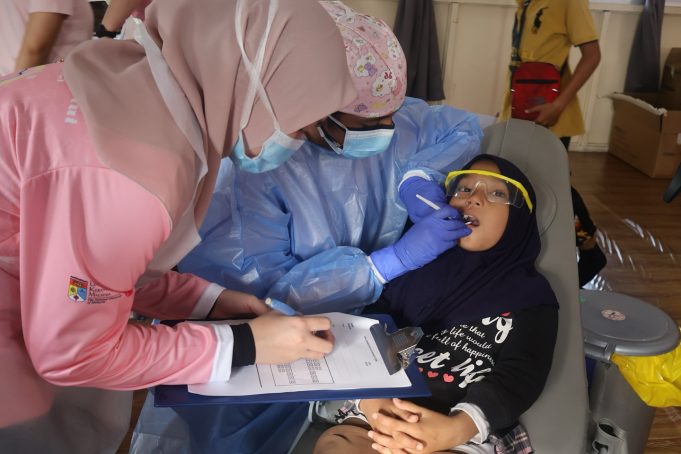
WHEN university offers are released, a mother and child refresh the portal together. An offer appears, but not for dentistry. They are grateful, yet disappointed. With grades this strong, they wonder why there was no place for the course they worked so hard for.
Every October, Malaysia’s faculties of dentistry begin a new academic year and admit undergraduates with promise and ambition. Many applicants have excellent grades and strong co-curricular records. Yet the number of qualified candidates far exceeds capacity.
Malaysia has 14 dental faculties. A typical public faculty offers about 50–80 places a year, yet may receive up to 700–800 qualified applications. This imbalance is not a judgment on any student; it reflects limits that protect quality and safety.
Quotas set by the MQA and the Malaysian Dental
Council (MDC) are tied to staff-to-student ratios and facility capacity, including dental chairs, lab workstations, teaching clinics, and patient flow. When intake exceeds capacity, training quality falls, clinical exposure shrinks, patient safety is at risk, and accreditation may be jeopardised.
These safeguards exist for students, patients, and the profession. Academic excellence matters, but it is only one part of the equation. Written exams show what a student knows; they do not show how a candidate communicates with anxious patients, manages stress, makes ethical decisions, or works with their hands.
Interviews and structured assessments help fill this gap. They allow admissions to identify candidates who are motivated, professional, resilient, and who have the aptitude to serve the public through patient care.
Capacity planning must also reflect the country’s actual needs. Intakes cannot be expanded in isolation; they must be matched with additional facilities, academic staff, clinical training sites, and clear career pathways. If graduate numbers run ahead of these supports, there is a risk of underemployment and uneven service distribution, with many dentists concentrated in cities and too few serving rural or underserved communities.
A careful and responsible admissions approach helps safeguard patients and ensures that graduate output aligns with national health priorities and the public investment made in training them. Recent media coverage of other competitive programmes shows the same dilemma.
Even top scorers do not always gain entry to a first-choice course because demand outstrips the seats available. When places are few and applicants are many, not everyone can be accommodated.
Not getting into a dental programme is not the end of the road. The qualities behind attaining high grades—discipline, critical thinking, and dedication—are valuable no matter where you go. Sometimes a different path reveals strengths and opportunities that are not obvious at first.
We hope this explanation helps parents, students, and the public understand why places are limited. If you do not receive an offer, your effort still counts, and your journey continues.
One decision does not define you. There are many ways to serve patients and communities. Take the path where your strengths do the most good, and let your potential unfold.
Prof. Dr. Tuti Ningseh Mohd Dom, BDS (Malaya), MPH (Michigan), PhD (UKMalaysia)
Dean, Faculty of Dentistry, Universiti Kebangsaan Malaysia. Jalan Raja Muda Abdul Aziz, Kuala Lumpur