
For the sake of posterity — and to deepen the understanding of future generations — Malaysia must honour the forefathers and leaders whose vision, service and sacrifice helped shape the nation.
Historical recognition should transcend political ideology. When the achievements of past leaders are diminished by present-day rivalries, the country risks weakening the shared memory and values that hold its people together.
Tan Sri V. Manickavasagam embodied this tradition of service.
Born in Klang in 1926, he was among the early generation of leaders of the Malaysian Indian Congress (MIC), founded in 1946. He entered Parliament in 1959 as the Alliance — the precursor to Barisan Nasional — representative for Klang, in the first general election after independence, and later became the MIC’s sixth president.
In that role, he led an institution that, across its 80-year history, has championed the rights, advancement and social inclusion of the Malaysian Indian community as an integral part of a young and growing nation.
Manickavasagam also belonged to a generation of Malaysian Indian leaders whose political awakening coincided with the birth of the Republic of India.
The MIC had emerged in 1946 from the wider current of Indian nationalism and was initially inspired by the Indian National Congress and India’s struggle for freedom.
Following India’s independence in 1947, however, the party progressively redirected its attention towards Malaya’s constitutional future, the question of citizenship and the full inclusion of the Indian community in the emerging nation.
Manickavasagam carried this transition forward. While valuing Malaysia’s enduring cultural and educational relationship with India, he worked to secure for Malaysian Indians a permanent and meaningful place in the political, economic and social life of their own country.
A national leader
His national career included service as a member of the Cabinets of three Prime Ministers — Tunku Abdul Rahman, Tun Abdul Razak and Tun Hussein Onn.
Working closely with the country’s founding leadership, particularly Tun Abdul Razak, he served during a defining period marked by the formation of Malaysia, Singapore’s separation from the Federation and the creation of the institutions of a modern developmental state.
His ministerial responsibilities encompassed labour, transport and communications.
As Labour Minister, Manickavasagam championed the principle that workers and their families deserved structured protection against employment injury and loss of income.
During his tenure, Malaysia was already examining the establishment of social security and invalidity pension schemes — efforts that helped lay the foundations for the country’s subsequent social security system and PERKESO.
His standing also extended beyond Malaysia.
At the International Labour Organization’s 54th International Labour Conference in Geneva in 1970 — a session that adopted major instruments concerning minimum-wage fixing and paid holidays — Manickavasagam became the first Malaysian to preside over the Conference, giving the young nation a respected voice in international labour affairs.
The birth of a national airline
His public service also coincided with a pivotal chapter in Malaysian aviation.
When Malaysia and Singapore decided to end their partnership in Malaysia-Singapore Airlines, Malaysia faced the challenge of establishing an independently controlled flag carrier capable of safeguarding domestic connectivity while expanding its international reach.
Malaysian Airline System was established in 1971 following the decision to separate the joint airline operations.
Malaysia-Singapore Airlines ceased operations in 1972 and the new Malaysian national carrier began operations on October 1 that year with a fleet of 19 aircraft.
Manickavasagam was among the senior Malaysian leaders serving during this important transition in the development of the country’s aviation sector.
His contribution to Malaysian aviation forms part of a wider record of public service during an era when many of the institutions associated with modern Malaysia were taking shape.
The Blue Book
Alongside these national responsibilities, Manickavasagam pursued a structured agenda for the advancement of Malaysian Indians.
After convening the First Indian Economic Seminar, he brought together leaders from business, politics and education to formulate the celebrated Blue Book.
Far more than a statement of aspiration, it represented an attempt to develop a coordinated socioeconomic programme centred on education, scholarships, technical and vocational skills, cooperative enterprise, investment and stronger community institutions.
The Blue Book can be seen as an early precursor to later efforts to formulate comprehensive development strategies for the Malaysian Indian community, including the Malaysian Indian Blueprint introduced decades later.
It demonstrated how far ahead of his time Manickavasagam was in approaching community advancement through long-term policy, institution-building and measurable socioeconomic progress.
This vision was translated into practical institution-building.
Under his leadership, the MIC strengthened its national organisation, promoted the Nesa Multipurpose Cooperative and MIC Unit Trust, established education and scholarship initiatives and supported technical and vocational training for Malaysian Indians.
Later institutions, including the Maju Institute of Educational Development and Maika Holdings, have also been associated with the broader development philosophy embodied in the Blue Book.
A Malaysian vision beyond one community
Yet Manickavasagam’s vision was never confined to a single community.
He championed the Malaysian spirit of muhibah — goodwill, mutual respect and social cohesion among the nation’s diverse racial and ethnic communities.
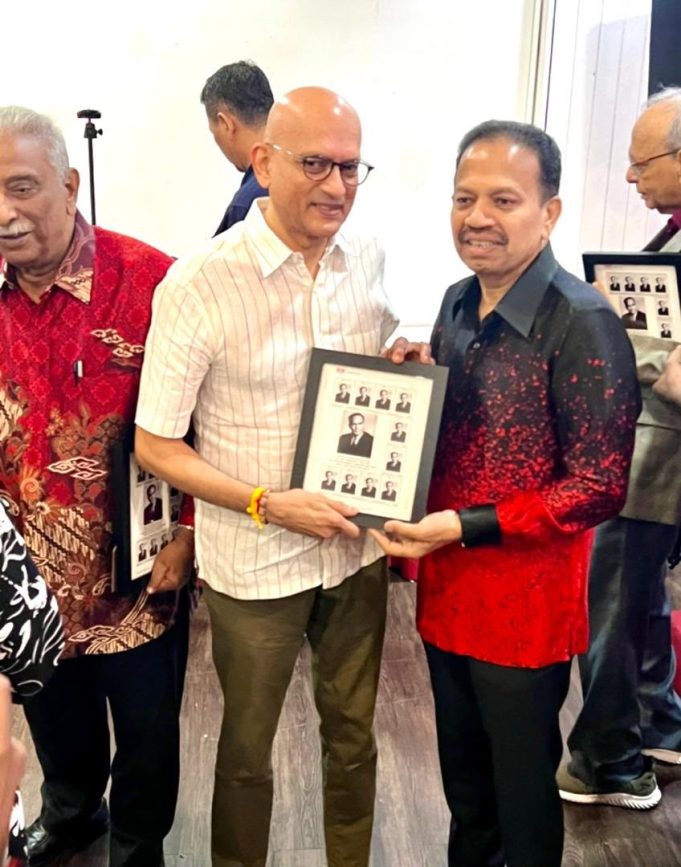
At the inaugural centenary commemorative-stamp function, former Cabinet minister, Menteri Besar of Negeri Sembilan and Dewan Negara president Tan Sri Dr Rais Yatim described him as an icon of Malaysian politics whose contributions reached beyond the Indian community and benefited Malaysians of every background.
Rais further urged that honouring earlier leaders who served the country and contributed to nation-building should become an enduring national tradition.
In this spirit, the Malaysian Indian Congress and its leadership — particularly its president, Tan Sri S. A. Vigneswaran, and deputy president, Datuk Seri M. Saravanan — deserve special commendation for commemorating the centenary of Tan Sri Manickavasagam’s birth and restoring his distinguished legacy to public attention.
This meaningful initiative affirms the MIC’s continuing commitment to honouring leaders who advanced the community while contributing to Malaysia’s broader development and unity.
Pos Malaysia likewise merits sincere appreciation for issuing the commemorative stamp.
More than a philatelic tribute, it is a tangible record of national history — one that will carry Tan Sri Manickavasagam’s memory to citizens, collectors and future generations, ensuring that his service to the nation is remembered with the dignity it deserves.
A confident and cohesive nation does not erase its past; it learns from it and gives credit where it is due.
By remembering leaders such as Tan Sri V. Manickavasagam without reducing their service to partisan labels, Malaysia affirms a culture of gratitude, fairness and historical maturity.
Such acts of remembrance strengthen the nation’s social fabric and ensure that the enduring values of service, unity and nation-building continue to inspire generations to come.
— Ravindran Devagunam is the nephew of the late Tan Sri V. Manickavasagam. The views expressed in this article are those of the author.