



By: Marja Azlima Omar
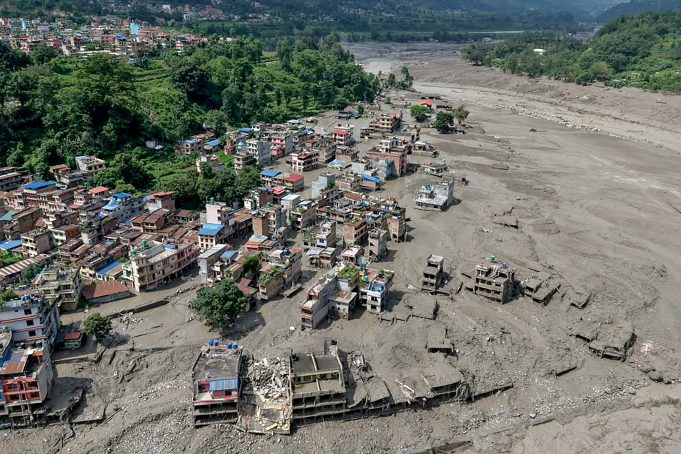
THE catastrophic ice-and-rock avalanche that struck the Nepal–Tibet border region on 26 August 2026 was more than an isolated mountain disaster. The collapse sent enormous quantities of ice, rock, water and debris into river systems, producing destructive flash floods that swept through settlements and damaged roads, bridges and hydropower facilities. Hundreds of lives were lost, thousands were reported missing, and tens of thousands were affected.
The immediate priority must, of course, remain the rescue of survivors, assistance to displaced communities and recovery of essential infrastructure. Yet as Nepal confronts this tragedy, the international community must also consider a difficult
question: why are environmentally vulnerable countries repeatedly left to bear the consequences of a crisis they did relatively little to create?
One useful way of approaching this question is through Garrett Hardin’s influential concept of the “tragedy of the commons”. In his 1968 essay published in Science, Hardin described a shared pasture that was freely available to a group of herders. Each herder had an individual incentive to place more animals on the land because the immediate benefit would belong to that person, while the resulting environmental damage would be distributed among everyone. If all the herders acted according to the same short-term calculation, the pasture would eventually be destroyed.
Hardin’s argument was that unrestricted individual freedom in the use of a finite shared resource could produce collective ruin. Although his original example concerned grazing land, the concept has since been applied to shared resources
such as forests, oceans, fisheries and, most importantly, the Earth’s atmosphere.
The atmosphere is perhaps the largest commons of all. No country owns it, yet every country uses it. For more than a century, states and industries have released greenhouse gases while enjoying the economic benefits of energy production,
industrialisation, transportation and consumption. The environmental costs, however, have been spread across the planet.
This creates an enormous imbalance. Major industrial economies have received much of the economic benefit, while geographically vulnerable societies face some of the gravest consequences. Nepal reportedly contributes only a very small fraction of global greenhouse-gas emissions, but its mountain communities are exposed to retreating glaciers, unstable slopes, changing precipitation patterns and increasingly unpredictable water systems.
Scientists must still investigate the precise combination of geological and climatic factors behind the August avalanche. It would be irresponsible to claim that climate change alone directly caused a particular glacier collapse before the evidence is complete. Nevertheless, experts have warned that unusually high temperatures can increase melting and weaken the frozen bonds that help hold mountain ice and rock together. Climate change therefore functions as a risk multiplier, making already fragile Himalayan environments potentially more unstable.
This is where Nepal’s tragedy resembles Hardin’s commons. Every government may believe that its own emissions, infrastructure projects or delays in reducing fossil-fuel dependence constitute only a small addition to the global problem. Yet when similar decisions are repeated across many countries, the cumulative result is a warmer and less stable climate.
The benefits remain concentrated, but the risks are shared. However, they are not shared equally. Mountain communities contribute little to the forces transforming the global climate, paradoxically they stand on the front line of its consequences. They have notably lost homes, livelihoods, cultural landscapes and essential infrastructure. The cost is then transferred again, this time to rescue agencies, humanitarian organisations, taxpayers and future generations.
The tragedy also exposes the limitations of governing environmental problems through national borders. Rivers, glaciers and weather systems do not respect political boundaries. An environmental disturbance occurring high in a transboundary
mountain range can rapidly threaten communities in more than one country. Effective protection therefore requires cooperation in scientific monitoring, satellite observation, hydrological information, early-warning systems and emergency
response.
Nepal and China cannot manage these dangers in isolation from one another. Nor should vulnerable states be expected to finance climate adaptation entirely from their limited national resources. The countries that have contributed most to historical emissions have a responsibility to provide accessible climate finance, technology and technical expertise.
However, Hardin’s theory should not be interpreted as proving that environmental destruction is unavoidable. Later scholarship, particularly the work of political scientist Elinor Ostrom, demonstrated that communities can successfully manage shared resources when they develop trusted institutions, clear responsibilities, monitoring systems and fair rules. The real problem is not necessarily the existence of a commons, but the absence of effective and equitable governance.
Applied to the Himalayas, this means strengthening regional disaster cooperation, improving cross-border data sharing, mapping high-risk glaciers and slopes, regulating construction in vulnerable valleys, and ensuring that warnings reach
remote communities quickly. At the global level, it means treating emission reduction and climate finance as enforceable responsibilities rather than charitable promises.
There is also a danger that the tragedy will be treated as a distant event i.e. a situation where another disaster briefly occupying international headlines before global attention moves elsewhere. Such indifference represents another form of the
commons problem. Governments may assume that some other party/parties will provide financial support, scientific resources or humanitarian assistance.
When every actor waits for another to respond, collective responsibility disappears. The lesson from Nepal is not that human activity created every avalanche. Avalanches and landslides have always formed part of mountain environments. The lesson is that human choices can intensify environmental instability, increase people’s exposure and determine whether a natural hazard becomes a humanitarian catastrophe.
The Himalayas are sometimes described as the “water towers of Asia” because their glaciers and snowfields support river systems on which vast populations depend. Their protection is therefore not solely Nepal’s responsibility. Their stability has regional and global significance.
Hardin warned that individually rational behaviour could lead to a collectively disastrous outcome. More than half a century later, the Nepal tragedy gives that warning an urgent human meaning. If the atmosphere continues to be treated as a
free dumping ground, vulnerable communities will continue paying for benefits enjoyed elsewhere.
The question is no longer whether humanity understands the tragedy of the commons. The question is whether governments are prepared to prevent it. Nepal’s suffering must not become merely another warning that the world acknowledges,
mourns and then later then forgotten until another disaster strikes.
 The writer is a Senior Lecturer, International Relations Programme Faculty of Social Sciences & Humanities, UMS.